

When an underground drain pipe is damaged beyond what a simple patch can fix, the traditional approach is to dig it up and replace it. But for the last few decades, two trenchless alternatives have offered a way to fix the pipe without ripping up the ground above it: pipe bursting and pipe lining. Both avoid the disruption, expense, and mess of a full excavation, but they work in very different ways and suit very different types of damage.
If you’ve been told your drain needs more than a jet and a rod, understanding the difference between these two methods helps you weigh up your options and make sure you’re getting the right fix for the problem. Here’s how they compare.
What is pipe bursting?
Pipe bursting is a trenchless method that replaces a damaged pipe with a brand new one without digging a full trench. A cone-shaped bursting head is pulled through the old pipe using a hydraulic winch. As it travels, the bursting head fractures the old pipe outward into the surrounding soil, and a new pipe (usually HDPE, high-density polyethylene) is pulled into position behind it.
The technique was actually invented in the UK in the 1970s by D.J. Ryan & Sons in partnership with British Gas, originally for replacing old cast iron gas mains. It’s since been adapted for drainage and sewer work, and it’s particularly useful when the old pipe is too badly damaged for lining but the pipe route is suitable for pulling a new pipe through.
Pipe bursting does need some excavation, but far less than a traditional dig. Access pits are required at each end of the section being replaced, one for the winch and one for feeding the new pipe in. These pits are typically around a metre square, which is a lot less disruptive than a trench running the full length of the pipe. Most domestic pipe bursting jobs can be completed in a single day, and because the new pipe follows the exact route of the old one, there’s no need to design a new pipe run or deal with changes in direction.
What is pipe lining?
Pipe lining (also called CIPP, cured-in-place pipe) repairs the existing pipe from the inside rather than replacing it. A flexible felt or fibreglass liner, saturated in epoxy or polyester resin, is inserted into the damaged pipe through an access point like a manhole or inspection chamber. Once in position over the damaged section, the liner is inflated against the inside walls of the old pipe using air pressure, and the resin is left to cure until it hardens into a rigid, smooth inner surface.
Modern systems use UV light to cure the resin, which takes minutes rather than the several hours needed for ambient-temperature curing. Either way, the result is the same: a seamless, joint-free inner pipe that seals cracks, closes gaps at joints, stops root intrusion, and gives the drain a new internal surface. The old pipe stays in the ground and acts as a structural shell for the new liner.
Lining needs no excavation at all in most cases. The equipment enters through existing access points, the liner is inserted from above, and the whole job can be completed with minimal surface disturbance. For properties where the pipe runs under a driveway, patio, extension, or mature garden, this is a significant advantage.
How they compare
What they fix
This is the most important difference between the two methods, and it’s the main reason one gets chosen over the other.
Pipe lining works when the old pipe is still holding its shape. Cracks, fractures, displaced joints, root intrusion at joints, and minor corrosion can all be fixed with a liner, as long as the pipe hasn’t collapsed or lost its circular profile. The liner needs a stable host pipe to sit against, and if the pipe has caved in, there’s nothing to support the liner properly.
Pipe bursting works on pipes that have gone beyond what lining can fix. Collapsed pipes, severely deformed pipes, heavily corroded pipes, and pipes that are too damaged to support a liner can all be replaced by bursting. Because the old pipe is deliberately destroyed during the process, its condition doesn’t matter as long as the bursting head can travel through the route.
Pipe diameter
Lining reduces the internal diameter of the pipe by a few millimetres (the thickness of the liner). For standard 110mm domestic drains, this reduction is negligible and the smooth resin surface actually improves flow compared to a rough, cracked pipe. The net effect on drainage capacity is neutral or positive.
Pipe bursting maintains the full original diameter, and in some cases can increase it. If you need to upsize a pipe (say from 100mm to 110mm, or from 110mm to 150mm), pipe bursting is one of the few trenchless methods that allows it. This makes bursting the better option if the existing pipe is undersized for the property’s current needs.
Disruption
Lining causes the least surface disturbance of any repair method. No digging, no pits, no heavy machinery on the property. The equipment fits through existing access points, and the surface above the pipe is left completely untouched.
Pipe bursting needs access pits at each end of the section being replaced, which means some digging. The pits are modest (typically a metre square), but they do require excavation and reinstatement. There’s also a small risk of ground movement during the bursting process, which can be a concern if the pipe runs close to other utilities, foundations, or neighbouring property. A competent engineer will assess these risks before starting work.
Speed
Both methods are significantly faster than traditional excavation. Pipe lining for a domestic section can be completed in half a day to a full day, including the CCTV survey, pipe preparation (jetting and robotic cutting if needed), lining, and curing. UV-cured liners harden in minutes; ambient-cure liners take a few hours.
Pipe bursting is similarly quick, with most domestic jobs done in a single day. The main time variable is excavating and reinstating the access pits, and the length of pipe being replaced. For a straightforward 10 to 15-metre run, both methods are comfortably same-day jobs.
Cost
Pipe lining typically costs between £80 and £250 per linear metre in the UK for domestic work, depending on the pipe diameter, depth, and accessibility. Pipe bursting is generally more expensive, starting from around £150 per metre and rising depending on the pipe material, diameter, and ground conditions. The access pit excavation and reinstatement add to the bursting cost.
Both are significantly cheaper than traditional open-cut excavation and replacement, which can run to £500+ per metre once you factor in trenching, backfill, and surface reinstatement. The exact cost difference between lining and bursting depends on the specifics of the job, but as a rule of thumb, lining is the cheaper option when the pipe condition allows it.
Lifespan
A properly installed CIPP liner has an expected lifespan of 50 years or more. The resin creates a seamless, corrosion-resistant inner pipe with no joints for roots to exploit. Manufacturer warranties typically cover 10 to 25 years, though the real service life often exceeds the warranty period.
A new HDPE pipe installed by bursting has an expected lifespan of 50 to 100 years. HDPE is flexible, chemically resistant, and has welded or fused joints that don’t deteriorate like rubber seals can. If longevity is your primary concern and the pipe needs replacing anyway, bursting gives you the longest expected service life of the two trenchless options.

When pipe lining is the better choice
Lining is the right method when the damage is containable and the pipe’s structure is still intact. The most common scenarios include:
- Cracks and fractures that haven’t caused the pipe to collapse
- Displaced joints that are letting roots in or causing leaks
- Root intrusion at joints that keeps recurring after jetting
- Pipes under driveways, patios, or extensions where even small access pits would be disruptive
- Situations where the pipe runs close to foundations or neighbouring property and ground disturbance needs to be avoided
- Preventive repairs to stop early-stage damage from getting worse
Lining is also the more practical option in tight or awkward locations where there isn’t room for the equipment needed to dig access pits, set up a winch, and feed in new pipe. The compact equipment used for lining can access the pipe through standard manholes and inspection chambers.
When pipe bursting is the better choice
Bursting comes into its own when the pipe is too damaged for lining to work. If the pipe has collapsed, deformed beyond its circular shape, or deteriorated to the point where a liner can’t bond to a stable surface, bursting replaces the entire pipe without the full disruption of a trench.
Other situations where bursting is typically the right call include:
- Collapsed or crushed pipes where there’s no intact host pipe to line
- Pipes that need upsizing to a larger diameter
- Pitch fibre pipes that have deformed and can’t support a liner
- Long, straight runs where the pipe route allows the bursting head to travel unobstructed
- Cases where the full pipe diameter needs to be maintained (no reduction from a liner)
Pipe bursting doesn’t work well around sharp bends, because the bursting head and the new pipe behind it follow a relatively straight path. If the pipe route has tight changes in direction, lining (which can navigate moderate bends) or traditional excavation may be the only options.
How a CCTV survey decides the method
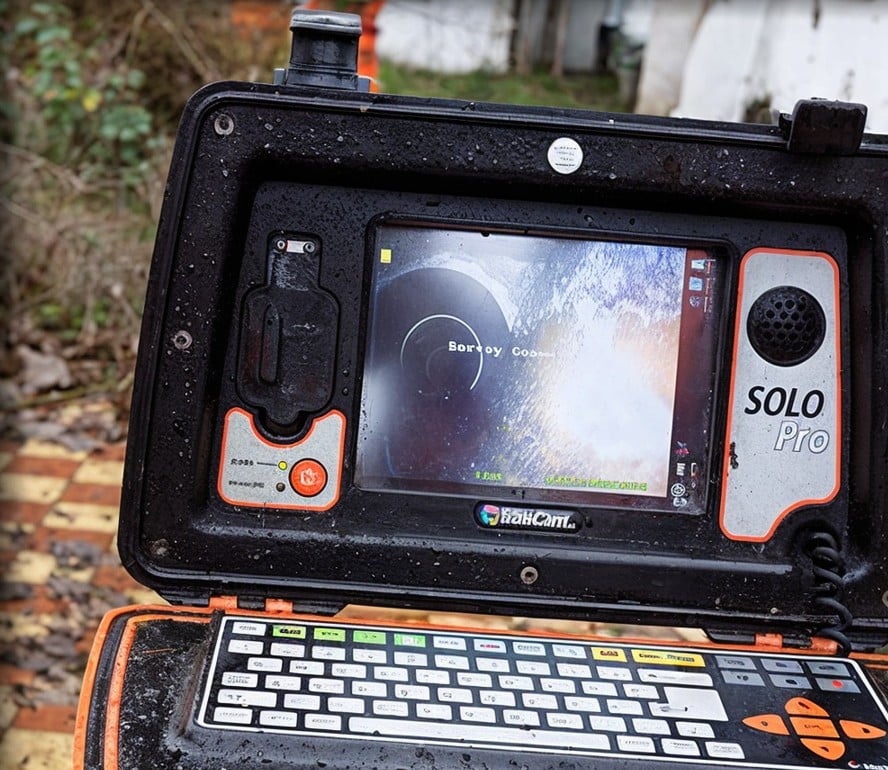
The choice between bursting and lining nearly always comes down to what the camera shows inside the pipe. A CCTV drain survey sends a camera along the full length of the drain, recording the condition of every section, joint, and bend. The footage shows whether the pipe has maintained its shape (lining is possible) or whether it’s collapsed or deformed (bursting or excavation is needed).
The survey also reveals the pipe material, diameter, depth, and route, all of which influence which method is most practical and cost-effective. Without a survey, you’re guessing, and guessing wrong means either paying for a method that doesn’t work or paying more than you need to for a method that’s overkill for the damage.

Frequently asked questions
Can you use pipe bursting on clay pipes?
Yes. Clay is one of the materials that pipe bursting handles well because the brittle clay fractures cleanly when the bursting head passes through. The old clay fragments are pushed outward into the soil, and the new HDPE pipe takes its place. It’s a common application of the technique on older domestic properties with deteriorating clay drains.
Does pipe lining reduce flow?
The liner adds a few millimetres to the wall thickness, which technically reduces the bore. However, the smooth resin surface improves flow compared to a rough, cracked pipe, so the effective drainage capacity typically stays the same or improves. For standard 110mm domestic drains, the reduction is too small to cause any practical difference.
How long does each method take?
Both are typically completed in a single day for domestic work. Lining may be slightly faster because there’s no excavation for access pits, while bursting includes the time to dig and reinstate the pits. UV-cured liners harden in minutes, making the drain operational almost immediately.
Which lasts longer?
A new HDPE pipe from bursting has a slightly longer theoretical lifespan (50-100 years) compared to a CIPP liner (50+ years), though both are long-term solutions that will outlast most mortgages. The practical difference in longevity is unlikely to matter for most homeowners.
Can both methods be used on the same drain?
Yes. On a long drain run with mixed damage, it’s possible to line the sections that are cracked but structurally intact and burst the sections that have collapsed. A drainage engineer will recommend the most cost-effective combination based on the CCTV survey findings.
Getting the right trenchless repair
Whether your drain needs lining, bursting, or a combination of the two, the decision starts with seeing what’s inside the pipe. Clark Drainage carries out CCTV drain surveys and both trenchless and excavated repairs across the UK. We’ll survey your drain, explain what we find, and recommend the method that gives you the best result for the least disruption and cost.
Call us on 0800 085 1219 for a free quote, or visit our contact page to book a survey.
